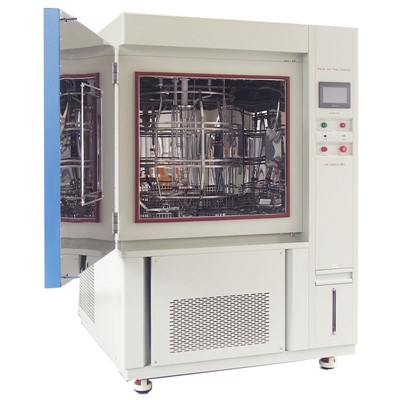



Hey there! As a supplier of Xenon Weatherometers, I often get asked about how these nifty machines handle the calibration of light sensors. Well, buckle up because I'm going to take you through the ins and outs of this process.
First off, let's talk a bit about why calibrating light sensors in a Xenon Weatherometer is so important. The Xenon Weatherometer, also known as a Xenon Accelerated Weathering Tester, is used to simulate the effects of long - term outdoor exposure on various materials. Light is one of the key factors in this simulation. Just like the sun, the xenon arc lamp in the weatherometer emits different wavelengths of light. If the light sensors aren't calibrated correctly, the results of the tests won't accurately represent real - world conditions.
The calibration process starts with a baseline measurement. We use a reference light source that has been carefully characterized. This standard light source has a known spectral power distribution, which means we know exactly how much light it emits at different wavelengths. By comparing the readings of the light sensors in the Xenon Weatherometer to the output of the reference source, we can establish a starting point for calibration.
We then measure the response of the light sensors across the spectrum. The sensors in the Xenon Weatherometer are designed to detect different wavelengths of light, similar to how our eyes can see different colors. But, just like our eyes can change over time, the sensitivity of these sensors can also drift. That's why regular calibration is a must.
One of the challenges in calibrating light sensors is dealing with the wide range of light intensities that the Xenon Weatherometer can produce. The xenon arc lamp can generate very bright light, comparable to the intense sunlight at mid - day in a sunny region. At the same time, we also need to be able to accurately measure lower light levels, like those during dawn or dusk. To handle this, we use a technique called multiple - point calibration.
In multiple - point calibration, we measure the sensor's response at several different light intensities. This gives us a more detailed understanding of how the sensor behaves across the entire range of light levels that the weatherometer can produce. We then use a mathematical model to adjust the sensor readings based on these calibration points. This model takes into account factors like the non - linear response of the sensor and any variations in its sensitivity.
Another aspect of calibration is ensuring that the sensors are measuring the right wavelengths. The xenon arc lamp emits a broad spectrum of light, from ultraviolet (UV) to infrared (IR). Different materials are affected by different parts of the spectrum. For example, plastics are often more sensitive to UV light, while some paints may be affected by both UV and visible light.
To make sure the sensors are accurately measuring the relevant wavelengths, we use filters. These filters are designed to block out unwanted wavelengths and allow only the specific wavelengths of interest to reach the sensor. During calibration, we check the performance of these filters and make any necessary adjustments.
The calibration process also involves checking the stability of the light sensors over time. We run a series of tests where the sensors are exposed to a constant light source for an extended period. By monitoring the sensor readings during this time, we can detect any signs of drift or instability. If we notice any changes, we can recalibrate the sensors to ensure accurate measurements.
Now, let's talk about the practical side of calibration. In our Xenon Weatherometers, the calibration is usually done using a software - controlled system. This system automates the calibration process, making it more efficient and accurate. The operator simply needs to follow a set of on - screen instructions, and the system takes care of the rest.
The software also stores the calibration data for future reference. This is important because it allows us to track the performance of the sensors over time and identify any trends or issues. For example, if we notice that the sensors are requiring more frequent calibration, it could be a sign of a problem with the lamp or the sensor itself.


We also provide training and support to our customers on how to calibrate the light sensors in our Xenon Arc Test Chambers. We understand that not everyone has a background in light measurement and calibration, so we make sure that the process is as easy to understand and follow as possible.
If you're in the market for a Xenon Weatherometer or need help with the calibration of your existing equipment, don't hesitate to reach out. We're here to provide you with the best products and support to ensure accurate and reliable weathering tests. Whether you're testing plastics, paints, textiles, or any other materials, our Xenon Weatherometers are designed to meet your needs.
In conclusion, the calibration of light sensors in a Xenon Weatherometer is a complex but crucial process. It ensures that the test results accurately represent real - world conditions, allowing you to make informed decisions about the durability and performance of your materials. With our advanced calibration techniques and software - controlled systems, you can trust that our Xenon Weatherometers will provide you with the most accurate and reliable data.
So, if you're interested in learning more about our Xenon Weatherometers or have any questions about calibration, feel free to contact us. We're always happy to help you find the right solution for your testing needs.
References
- ASTM standards related to xenon arc weathering testing
- Technical literature on light sensor calibration and measurement